



Welcome to Nuclear Notes on Substack

Nuclear Notes is produced by the Breakthrough Institute, and covers the policy, regulation, technology, and business of advanced nuclear energy in the United States and beyond.
Every Thursday, we track what’s really going on in the field: the new rules moving through the Nuclear Regulatory Commission, the advanced reactors moving from design to deployment, the companies going public and the utilities merging, and the executive orders and acts of Congress reshaping how the country builds. We explain not just what happened, but why it matters and how the pieces fit together.
We write for readers who want substance: policymakers, industry professionals, investors, researchers, and anyone trying to follow nuclear energy as it takes on a larger role in the world.
After years on Mailchimp, we’ve moved Nuclear Notes to Substack. For you, not much changes—it still arrives every Thursday in your inbox. But Substack gives the newsletter a permanent home on the web, so past issues are now easy to browse and search.
Nuclear Notes is written by Matthew L. Wald, a longtime energy and nuclear journalist with more than 35 years of experience at The New York Times, with assistance from Spencer Toohill, Chief of Staff for Breakthrough’s Nuclear Energy Innovation team.
An Advanced Reactor Goes Critical
Antares Nuclear beat the symbolic, but real, deadline of July 4 set in President Trump’s Executive Order 14301 of May 2025, and achieved initial criticality in a prototype of its microreactor on June 4 in a demonstration at the Idaho National Laboratory.
Initial criticality, sometimes called zero power criticality, is a key milestone in reactor development. The reactor may generate only a few watts of power, but it is a test that can confirm the geometry of the core and provide data needed for licensing. This is particularly significant as the industry moves beyond the familiar light-water reactors, in which water moderates the speed of the neutrons to improve conditions for fission, and carries the heat away for conversion into electricity. All the models moving towards initial criticality now are of less familiar designs, using inert gas, molten metal, or salt as the working material to carry away the heat so it can do useful work. Some under development are “fast” reactors, meaning that there is no water or other material to slow down the neutrons, and these can fission a wider variety of materials. But all of the ones expecting to achieve initial criticality soon have neutrons that are slowed down.
“Initial criticality” has changed its meaning slightly in the current round of nuclear development. Big reactors were not prototyped the way small ones are being developed today, and initial criticality in the Westinghouse AP1000 was in the first commercial model. The Antares reactor is still a work in progress, and the company anticipates iterative development, with several models built and tested before the final commercial version is ready, with a goal of commercial operation by September 30, 2028.
So, while initial criticality in the power reactors running today was a sign that construction was done and start-up testing was well under way, in the new class of advanced reactors it is a step in prototyping, and just one in a long development process. In big reactors, it was a step toward commercial operation of that particular reactor; now, it’s a step that developers say will lead towards stamping out repeated copies of the same commercial machine.
Previously, initial criticalities were usually part of the NRC licensing process. The initial criticality for Antares and any others that follow in the next few weeks is following a different path, with approval by the Energy Department rather than the Nuclear Regulatory Commission. The latter’s approval would be required for civilian deployment.
NRC approval will not be required for use by Antares’ launch customer, the Defense Department, which wants it for reliable production at military bases. It can also be used in space. It has an output of 200 to 300 kilowatts, according to the Department of Energy, and can run for at least three years without refueling. It uses sodium coolant and high-assay low-enriched uranium (HALEU) in TRISO form, which consists of small kernels of uranium encased in layers of heat-resistant materials, with the fuel itself providing the primary radiation barrier.
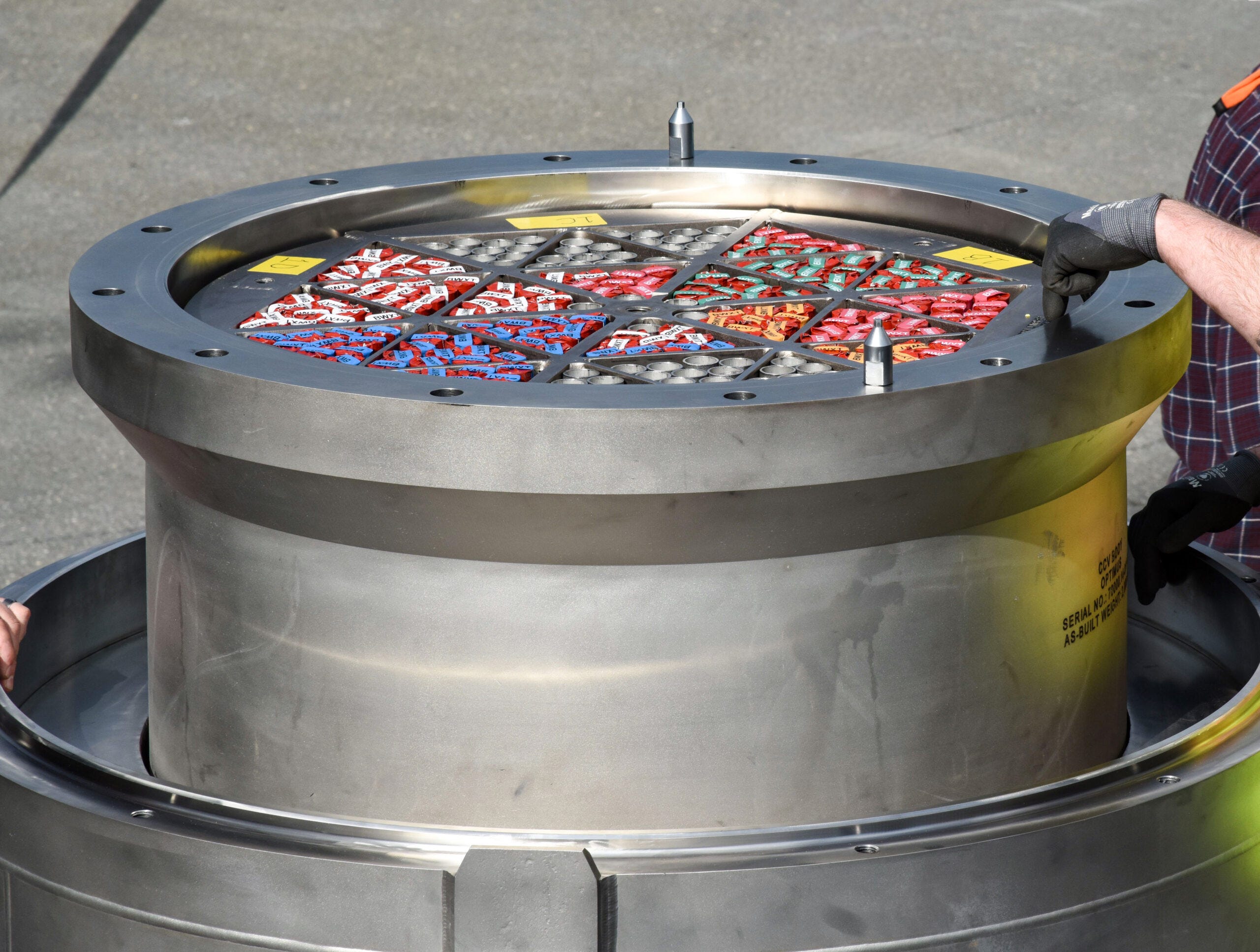
It does not resemble large power reactors. Reactivity control is provided by drums made of graphite, which can be turned to help the nuclear reaction by slowing down the neutrons. Drums of boron carbide, which slows the reaction by absorbing neutrons, can also be maneuvered. Controls are automated. But the test apparatus in which criticality was achieved was a long way from a power reactor; it did not have a mechanism for removing heat from the core, or converting it into electricity.
Trump’s goal was at least three new reactors reaching initial criticality by July 4, and the Energy Department has approved the preliminary safety analysis of four: Antares in January of this year, Radiant Industries in February, and Valar Atomics and Aalo Atomics in March.
Valar Atomics, which is developing a high-temperature gas-cooled reactor, reached initial criticality last November in a demonstration at Los Alamos National Laboratory, in a test configuration that closely resembles what it is planning to use in its reactor. It also uses TRISO fuel, and HALEU. Whether this counts towards the goal of three by July 4 is not clear, but it is a milestone in any case.
Radiant’s model is also small, designed to replace diesel generators, especially in places where delivering diesel is hard. It can make electricity, or provide up to 1.9 megawatts of thermal power, for heating or desalinating water.
Aalo’s reactor is larger, 50 megawatts, and intended for data center customers. It uses uranium enriched up to 10 percent and is cooled by helium
Plutonium, anyone?
Five companies have now confirmed that they’ve been selected by the Department of Energy as potential recipients of surplus plutonium from the weapons program, for use in their advanced reactors.
The Department itself has had extensive troubles with the chemical processing involved, and has dropped its efforts, but wants the private sector to take on the job. Weapons plutonium is sometimes alloyed with another material, gallium, to stabilize it, but that is undesirable in water-based reactors for technical reasons. And the operators of today’s water-based reactors were not eager to use plutonium because doing so would require applying for a license amendment from the NRC, which can be a long, costly process. And their regular fuel source, low-enriched uranium, is readily available.
In contrast, many of the advanced reactors are not water-based, and their developers would prefer plutonium in the mix, because plutonium produces more neutrons per fission. There are technical obstacles, however. One is that over time, the plutonium breaks down into decay products that are also undesirable, like americium. But SHINE Technologies, of Janesville, Wisconsin, says that it will work with a partner, Zeno Power, to remove americium from the plutonium. It is one of the companies that is in line to receive government surplus plutonium.
There are four other companies that would want plutonium fuel as an option. Exodys Energy is developing an electrochemical technology that it intends to deploy in modular recycling units. Standard Nuclear plans to produce TRISO fuel, which can be used in a variety of designs. The company says it is “reactor agnostic.”
Flibe Energy is developing a liquid fluoride thorium reactor. Thorium is not fissile but it is “fertile,” needing to capture a neutron to convert into uranium-233, which is a reactor fuel. Getting started requires a fuel that is fissile, and plutonium fits well into the company’s plans. An advantage of a thorium cycle is that the reactor has less uranium-238, which, when it captures a neutron, becomes yet more plutonium.
Oklo is developing small fast reactors and would also like the plutonium. “Fuel supply constraints are a key throttle to advanced reactor development,” the co-founder Jacob DeWitte, told World Nuclear News. Oklo plans a $1.7 billion recycling plant in Oak Ridge, Tennessee, to do the work.
These are mostly small start-ups without extensive physical assets, although some are well-funded. The Energy Department authorization will allow them to proceed outside the NRC’s licensing framework for testing and piloting, but they will still face major technical challenges, and security requirements.
TMI Restart is Off-Again, On-Again
When Constellation shut its Three Mile Island 1 reactor in September 2019, it quickly ruined some key pieces of equipment to lower its carrying costs during decommissioning. But the longest lead-time item in the restart of the reactor, now called the Crane Clean Energy Center, has been getting permission to re-connect to the grid. The regional grid operator, the PJM Interconnection (for Pennsylvania-Jersey-Maryland) has a queue.
With pressure from the governor of Pennsylvania, Josh Shapiro, PJM moved the plant to the front of the line, but then it moved it back again. Now the Federal Energy Regulatory Commission has stepped in, and ruled that Constellation can re-start the plant by transferring connection rights from a gas-fired plant that it is planning to retire. So the re-start is back on track for 2027.
And, on Tuesday, the NRC ruled that re-starting the plant would not require a full Environmental Impact Statement.
Another Weak Link in the Supply Chain?
A survey of 35 nuclear academic programs by the Oak Ridge Institute for Science and Education, updated in 2024, found that nuclear engineering programs awarded 27 percent fewer bachelors degrees in 2022 than in the years 2016 to 2019, and that graduate enrollment was also down slightly. That probably portends a drop in graduate education too.
Even More Vertical Integration
Oklo is already unusual for planning to sell heat and electricity, not reactors, but it has taken another step towards vertical integration: it has bought a company that can make fuel and components for nuclear reactors.
Addressing Fusion’s Proliferation Potential
Two good fuels for nuclear weapons, plutonium-239 and uranium-233, are made by capturing stray neutrons released in the chain reaction of a fission reactor, and transmuting readily-available atoms that are able to absorb a neutron (fertile), but not able to split (fissile) until they do so.
Fusion reactors, though, produce neutrons in abundance, and could be used to surreptitiously produce weapons fuel. Now, scientists at Princeton and Virginia Tech have proposed a novel way to detect such production, with a machine that senses anti-neutrinos.
See a story we missed or one that you think should be included, let us know in the comments or message us!
Note: An earlier version of this post stated incorrectly that Aalo was planning to use TRISO fuel.
Aalo does not use TRISO. They opted to use standard fuel to minimise the supply chain risk associated with HALEU. See https://www.reuters.com/business/energy/low-enriched-uranium-could-offer-faster-deployment-small-reactors--reeii-2026-03-24/.
No heat removal or electricity generating machinery? In the 1940's, such "criticality" was achieved by two small chunks of uranium and a screwdriver. This "criticality" was nothing more than a cheap publicity trick.