



Nuclear Notes is produced by the Breakthrough Institute, and covers the policy, regulation, technology, and business of advanced nuclear energy in the United States and beyond.
Every Thursday, we track what’s really going on in the field: the new rules moving through the Nuclear Regulatory Commission, the advanced reactors moving from design to deployment, the companies going public and the utilities merging, and the executive orders and acts of Congress reshaping how the country builds. We explain not just what happened, but why it matters and how the pieces fit together.
A Nuclear Company Goes Public, and It’s Not a Startup
Westinghouse, which has been privately held since 2018, wants to go public again. This would be different from the other initial public offerings in the nuclear field, because Westinghouse is a major presence in the business of fueling and maintaining the current fleet.
Westinghouse’s corporate history is an odyssey worthy of a Hollywood epic. It was founded in 1886 by a Civil War veteran, George Westinghouse, whose first major invention was a braking system controlled by compressed air that revolutionized rail safety. By the late 1880s he had moved into the electricity field. His company was a competitor to Thomas Edison’s.
In 1957, the company supplied the first commercial pressurized water reactor, an upscaled version of a submarine propulsion reactor. In the 1900s Westinghouse went into everything from elevators to mortgage lending to appliance manufacturing. It bought the CBS television network, renamed itself after the company it had acquired, and spun off its nuclear business. It sold the nuclear portion to British Nuclear Fuels Ltd. (BNFL) in 1999, for $1.1 billion. BNFL sold it to Toshiba in 2006 for $5.4 billion.
But Westinghouse went bankrupt trying to finish the Vogtle reactors in Georgia, which it offered at a fixed price. It was bought by a Canadian turn-around firm, Brookfield Asset Management, for $4.6 billion. Brookfield sold a minority stake to another Canadian company, Cameco, a uranium miner.
In October 2025, Brookfield and Cameco announced a partnership with the United States government, with Washington promising to procure $80 billion from Japan to finance new reactors. If Westinghouse and the Energy Department hit certain milestones, the U.S. Treasury could end up with 20 percent of the stock.
The company has a lucrative business servicing Westinghouse reactors around the world, supplying fuel, performing upgrades, and doing specialized maintenance work. It is developing a microreactor called eVinci, and trying to sell more copies of its big reactor, the AP1000, in the United States, Eastern Europe, the Middle East, and Asia. The on-again, off-again deal between the Trump administration and Saudi Arabia would be for AP1000s.
If a significant number of AP1000 reactors are ordered for export, or if the Trump administration meets its goal of having ten big reactors under construction in this country by 2030, Westinghouse would need significant additional capital just to meet the role of a seller of nuclear steam supply systems, which is the role it played when the current fleet was built. At Vogtle it took on a bigger role of actually managing construction, which it might do again.
Several nuclear start-ups have gone public, but they would be dwarfed by Westinghouse. And all of those businesses are based on technologies that have not been commercialized yet, in contrast to the AP1000, a commercially deployed design with two operating units at Vogtle and four in China.
The AP1000 is in a class referred to as “generation III+,” meaning that it is similar in broad outline to reactors now running, being water-moderated and water-cooled. But it is optimized to use passive forces in an accident (AP stands for Advanced Passive).
Because it is not so radical a departure from today’s pressurized water reactors, it may be more attractive to some companies that already operate reactors. And while it is clearly not a small modular reactor, Westinghouse says it is “modularized,” meaning that major components can be built in a shipyard or other factory and shipped to the site.
That turned out to be a major flaw at Vogtle, because the shipyard picked to supply the modules had difficulty meeting the schedule and NRC-mandated quality control requirements.
Westinghouse also has an SMR design, the AP300, which uses many of the same components as the AP1000. Potential developers have not publicly expressed much interest in the AP300. But Westinghouse has announced agreements with Amentum, an engineering firm, to support deployment of both AP models.
Terms of Westinghouse’s initial public offering have not been disclosed, so the proposed valuation and the debt structure are not clear. Neither is the timing, which could depend on market conditions and regulatory approvals.
A New Try at Harvesting Uranium from Seawater…
The oceans hold 4.5 billion metric tons of uranium, equal to many thousands of years of consumption. But the uranium is at a concentration of only about 3.3 parts per billion.
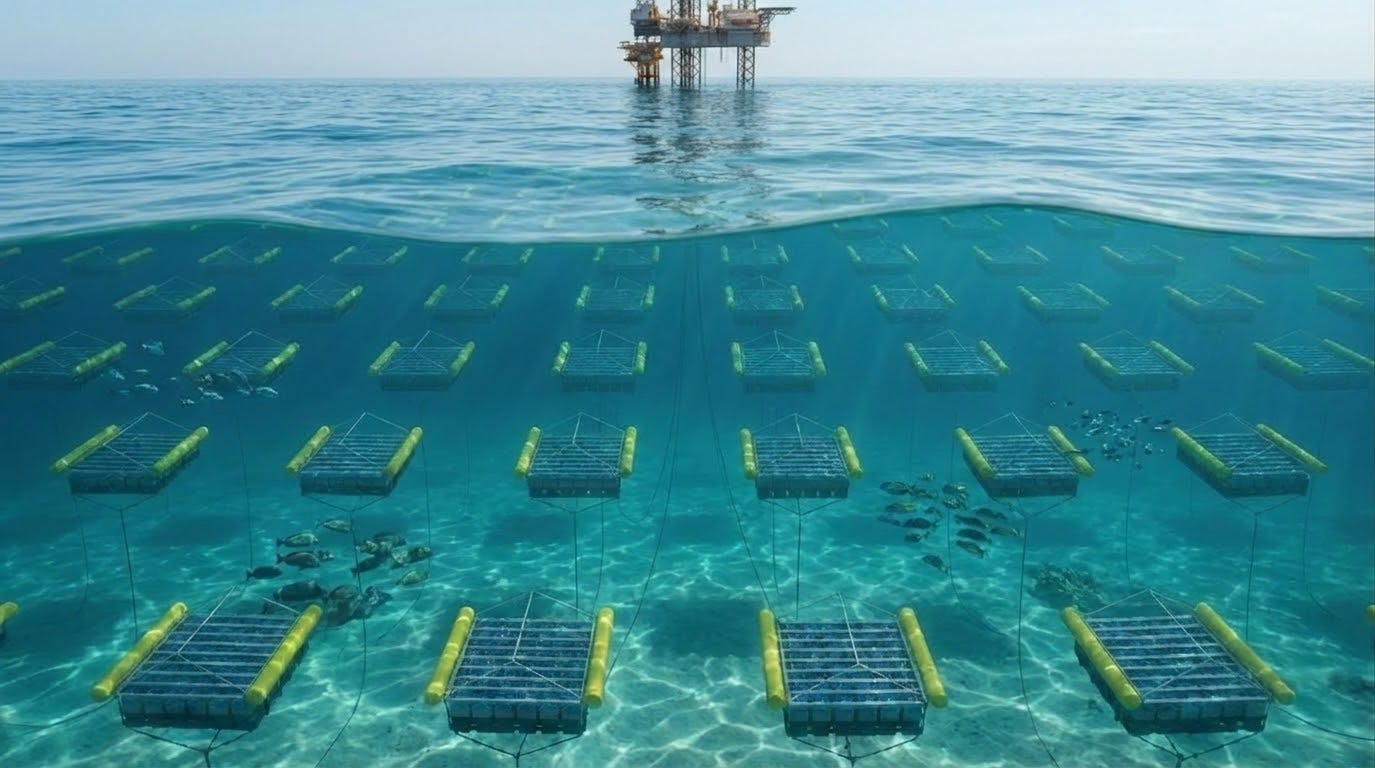
A start-up in Austin, Texas, SuperCritical Materials, is preparing to demonstrate a new technology that will concentrate the uranium by a factor of more than 1 million, to 4,000 parts per million. That would still need additional processing, but compares favorably to uranium ore taken from on-shore mines. “That’s pretty darn good in the uranium mining world,” said Canon Bryan, the company president and chief executive.
The company has a fiber that preferentially adsorbs uranium molecules. “Adsorption” means making materials stick to a surface, like flies on fly paper, as opposed to “absorption,” when the material is chemically incorporated. It spreads one gram of the material on 7 square kilometers of acrylic fibers. The fibers are immersed in seawater for three weeks and then pulled out, and the uranium, in a carbonate form, is stripped off for processing.
The company says it has raised $4.5 million privately. And it anticipates receiving more money through a $20 million grant that BP made to a nonprofit, the Gulf Offshore Research Initiative (GORI), following BP’s 2010 oil spill in the Gulf. GORI is also giving SuperCritical access to a defunct oil drilling platform.
SuperCritical is planning an initial public offering of stock, but it has also attracted an investment from Neal Froneman, who has led several conventional on-shore uranium mining companies. Froneman has also become chairman of the board.
According to Bryan, the technology can produce uranium at a cost competitive with today’s spot price. But SuperCritical won’t complete a full-scale demonstration until next year.
China has experimented with recovery from the sea, as has the Woods Hole Oceanographic Institution, with the Pacific Northwest and Oak Ridge National Labs.
If any of the technologies work, the supply is nearly inexhaustible, because as the concentration of uranium in seawater is lowered, more leaches into the water from subsea rocks.
…And Enriching Uranium for Reactor Fuel
Two U.S. Senators have proposed legislation to rationalize regulation of new enrichment plants. Mark Kelly, a Democrat from Arizona, and Cynthia Lummis, a Republican from Wyoming, have introduced the Modernizing Outdated Regulations to Expand American Fuel Act, which, among other changes, would let builders start on new enrichment plants before they have an operating license in hand.
The Breakthrough Institute supports the changes. “The United States lacks the domestic uranium enrichment capacity needed to support significant growth in nuclear energy,” said Dr. Adam Stein, Director of Nuclear Energy Innovation at Breakthrough. “Expanding that capacity is essential to enabling American nuclear deployment and strengthening energy security.”
“This approach allows construction and licensing to proceed in parallel without prejudging or limiting the NRC’s final licensing decision. The bill appropriately preserves the NRC’s full authority over the operating license while maintaining public participation and advance notice for surrounding communities,” he said.
Another Initial Criticality
Another microreactor has reached criticality, this one designed by Los Alamos National Laboratory. The ZiaCore reactor used low-enriched uranium in a ceramic form with a very high melting point. It is moderated with a zirconium hydride material.
It was designed to accommodate higher enrichments when that type of fuel is more readily available.
Los Alamos said that the reactor was brought to criticality in April and May, before the rush of private-sector designs that were struggling to beat President Trump’s July 4 deadline. The purpose of this criticality, like the ones produced by start-up companies, was to validate the core design, part of a long process toward commercialization.
A Nuclear Startup Chooses an Old-School Route to Safety
TerraPower, which is developing a plant in Wyoming that marries a high-temperature fast reactor to a heat battery, has joined the Institute of Nuclear Power Operations (INPO), a low-profile organization that is hugely influential within the industry. INPO was founded after the Three Mile Island accident in 1979 and sends audit teams to monitor operations, in a peer-to-peer process that industry observers say is more intensive than the NRC’s.
INPO was formed decades ago with the belief that a nuclear accident anywhere was very bad news for all the companies in the industry, worldwide.
TerraPower is the first advanced reactor company to join INPO.
A Nuclear Site Could Get a New Tenant
Fossil fuel and renewable plant developers often “re-power” their sites, tearing out old equipment and replacing it with something more modern. Now Holtec, which decommissions old reactors, may do the same at the Oyster Creek Generating Station in New Jersey.
The site used to host a 636-megawatt boiling water model, and was a milestone in the industry because GE offered it as a turnkey project, to get the technology rolling. It operated from 1969 to 2018.
Holtec is developing a 300-megawatt small modular reactor design and is now proposing to put four of them at the Oyster Creek.
Thanks for reading!
The 1957 Shippingport reactor wasn't a submarine reactor; it was a large ship reactor then under development by the Navy. Hyman Rickover had it modified to use low-enriched uranium, a deliberate change to make it proliferation-resistant.--Richard Rhodes