



Nuclear Notes is produced by the Breakthrough Institute, and covers the policy, regulation, technology, and business of advanced nuclear energy in the United States and beyond.
Every Thursday, we track what’s really going on in the field: the new rules moving through the Nuclear Regulatory Commission, the advanced reactors moving from design to deployment, the companies going public and the utilities merging, and the executive orders and acts of Congress reshaping how the country builds. We explain not just what happened, but why it matters and how the pieces fit together.
Giving Nuclear Waste Another Chance
The Energy Department has announced that it has selected five states as potential hosts for “Nuclear Lifecycle Innovation Campuses.’’
Utah, Tennessee, Oklahoma, Louisiana and Idaho will “continue exploring opportunities,” according to the announcement, which says that the campuses will “support activities across the full nuclear fuel cycle, including fuel fabrication, enrichment, reprocessing used nuclear fuel, and final disposition of nuclear fuel.” It could also include new reactors.
Waste disposition has been part of the deal since the initial Request for Information earlier this year. Tennessee and Utah said they would consider burial. Idaho said it was open to “long-term monitored storage.” Oklahoma and Louisiana did not make their proposals public.
The department got 28 applications from 26 states, and describes these five as “initial contenders.” Governors of the five states gave effusive tributes to the fuel hub idea.
The Trump Administration is not looking only for a burial site, but for a major industrial complex, pairing what has been seen as a burden with economic and development incentives. One of those incentives is the opportunity to “reprocess” spent nuclear fuel, which would separate unused uranium and usable plutonium generated in reactor operation, and fabricate them into new fuel.
Reprocessing has been a sticky subject and was shunned by the Ford and Carter administrations, because it can be used to purify materials that can be used in nuclear weapons. The theory was that reprocessing here would set a poor example for other countries. Reprocessing is also expensive. But it recovers valuable unused fuel, shrinks high-level radioactive waste volumes, and yields useful industrial isotopes.
The Trump administration has embraced the idea, and suggested that the job should be undertaken by the private sector. “These campuses will be massive generators of economic growth, create thousands of high-paying jobs, and be crucial to unleashing America’s nuclear renaissance,” Energy Secretary Chris Wright said in a statement. By the Energy Department’s estimate, a fuel cycle campus could draw in $50 billion in capital investment, and generate billions in tax revenue and nearly 25,000 jobs.
Establishment of a reprocessing system, and a repository for the material that can’t be recovered for re-use, would resolve a frequent question from nuclear opponents: “What about the waste?” Use of plutonium-239 would also reduce the amount of uranium that must be enriched to produce reactor fuel.
The companies that operate today’s nuclear reactors have not shown much enthusiasm for reprocessed fuel, because using virgin uranium is cheaper and simpler. However, many light-water reactors in Europe run on such fuel, and some advanced reactors now under development could also use that fuel. Reprocessing would also reduce the amount of material that the federal government pays to store. So far the government has paid over $11 billion, and now pays about $800 million per year, because it promised to begin taking the waste in 1998, in exchange for collecting a fee from the utilities for each kilowatt-hour generated by reactors.
A court suspended the fee because the Yucca program fell apart. Including interest, the Nuclear Waste Fund has a balance in excess of $47 billion.
Among the challenges is that currently, Federal law says that the Energy Department will build a repository. Only one U.S. nuclear plant, Palo Verde in Arizona, was designed to use fuel with reprocessed plutonium, and several TVA reactors have been evaluated for that purpose. Many light-water reactors in Europe run on such fuel, and some advanced reactors now under development could also use that fuel.
Notably absent from the list is Nevada, which was selected by Congress in 1987 as America’s waste repository site. That effort died when Harry Reid of Nevada became the Senate Majority Leader and cut off funding. And when then-Senator Barack Obama of Illinois ran in the Democratic Nevada Primary for president, he promised not to pursue the site. So the location chosen by Congress, Yucca Mountain, is still the law of the land and the only legal site, but is politically unviable.
For any other geologic repository site to move forward, the Nuclear Waste Policy Act is going to have to be amended. That amendment, debates over reprocessing, and the Nuclear Waste Fund are still points of contention that will need to be resolved in order to enable the Nuclear Lifecycle Innovation Campuses.
Oklo Inches Forward Toward Licensing
Oklo, which wants to build and operate small reactors around the country, is technically still in the pre-application phase of licensing with the NRC for its 75 MWe Aurora Powerhouse, but reports progress on a few avenues.
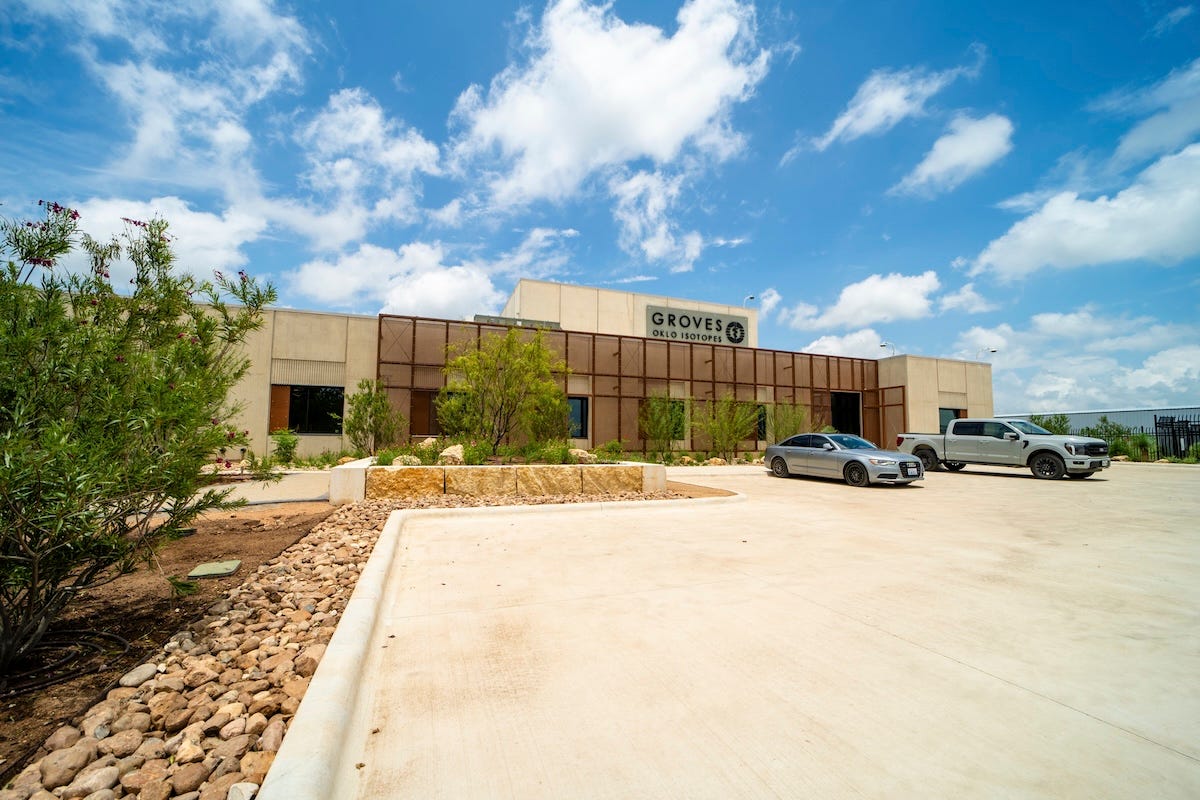
Last week, Oklo received DOE authorization for one of its other business plans, the Groves isotope-producing pilot reactor in Texas.
The Groves reactor has a maximum power level of 100 watts of heat energy. It does not make electricity. It is being built under the Department of Energy’s Reactor Pilot Program, not licensed by the NRC. It is on private land, about 30 miles south of Austin. The commercial design is planned to be 15 megawatts thermal, or a million and a half times larger. The start-up authorization allows Oklo to load fuel, test, and operate the reactor.
According to Oklo, the project “demonstrates nearly every element of a commercially oriented deployment model that Oklo can repeat and scale across future projects.” That includes construction, sourcing the fuel, and manufacturing or purchasing all the components, and training the operators. “Future Oklo projects will build on the established systems, qualified suppliers, and approved operating programs established through Groves,” the company said.
In addition, Oklo is building its Aurora reactor at the Idaho National Laboratory under DOE’s Reactor Pilot Program. In contrast to other reactor projects at the Idaho National Laboratory, the company’s plan is to construct and operate its FOAK pilot reactor under Energy Department rules, but later to get the plant approved by the NRC so it can sell electricity commercially. With DOE authorization “we can get to construction much quicker,” said Bonita Chester, head of communications. Oklo is consulting with the NRC along the way, she said, but it is building under DOE approval which is faster and easier to get. Oklo’s Quality Assurance program for the Aurora has already been accepted for review by the NRC.
The company’s work with NRC amounts to a do-over. In March 2020, Oklo submitted an application to build a power reactor. But in January 2022, the NRC rejected the application due to “significant information gaps in its description of Aurora’s potential accidents as well as its classification of safety systems and components.”
The NRC dismissed the application “without prejudice,” meaning that it could be re-filed.
Bill Proposes to Codify State Department Effort to Promote Advanced Nuclear Energy Abroad
The Foundational Infrastructure for Responsible Use of Small Modular Reactor Technology (FIRST) program was set up in 2021. Senators Chris Coons, Democrat of Delaware, and Ted Budd, Republican of North Carolina, are seeking to heighten nuclear cooperation and U.S. exports by codifying the program into statute.
This State Department effort began during the Biden administration to help non-nuclear countries develop their capacity to regulate and build small modular reactors.
The Breakthrough Institute is among the nuclear advocates endorsing the bill. “Strengthening U.S. leadership in nuclear energy deployment abroad and supporting the safe, secure expansion of nuclear power globally are a natural extension of the American nuclear industry’s growth, and should be prioritized for energy security, clean energy goals, and national security alike,” said Adam Stein, Director of Nuclear Energy Innovation at the Breakthrough Institute. The bill would codify FIRST “as an instrument of commercial statecraft,” he said.
Trump Administration Considers Offshore Reactors
The NRC and the Marine Minerals Administration, which administers the Outer Continental Shelf, have signed a memorandum of understanding to coordinate their activities if an applicant wants to build a reactor offshore. One possibility is reactors on the sea floor, although neither those nor floating reactors have been proposed.
Reactor manufacturers have thought for years about floating reactors, which would sit on barges, and their technical specifications. Westinghouse designed several plants with baskets of ice in the containments to absorb excess energy in an accident. These were built on land, but the containments were smaller and thus potentially better suited to being built on barges, if a utility wanted to do so.
And in November 2024 Westinghouse signed an agreement with Core Power to explore putting Westinghouse’s eVinci microreactor on barges for near-shore use.
Nine Illinois Communities Are Interested in Nuclear
Early this year, Illinois repealed its 1987 moratorium on new reactors, and went looking for potential hosts for new nuclear deployment in the state. Nine communities have raised their hands.
Six already have reactors, including Constellation’s Clinton plant, which already has an early site permit.
One has a decommissioned coal plant and another has a coal plant that will retire soon. And the University of Illinois Urbana-Champaign is continuing to pursue a demonstration reactor that would replace natural gas in making steam for the campus heating system.
Thanks for reading!
American physicists John Holdren, Thomas Cochran, Frank von Hippel, and others have worked tirelessly for sixty years to stop used fuel recycling and advanced nuclear power technologies. These technologies are essential for plentiful energy for the modern world. These alarmist scientists are serious threats to peace and prosperity with their unfounded claims of this being a path to nuclear proliferation. I've discussed these topics with Holdren since 1970 and von Hippel since 2010. They do not appreciate me.
The argument that reprocessing "sets a bad example" because the plutonium can be used to make nuclear weapons can be applied to many technologies: artificial fertilizer should be forbidden because a truckload of fertilizer doused with diesel fuel makes a car bomb; no one should be allowed to handle cellulose because it can be mixed with nitric acid to make explosives; steel should be banned because it can be used to make rifle barrels and bayonets. Everything will be safe once we get back to hunting and gathering.